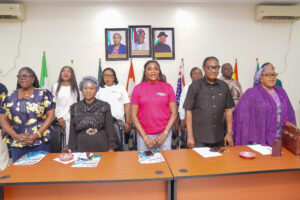

Nigeria Emerges as Africa’s HR Powerhouse with Historic Launch of First CIPD-Approved Centre

By: Sesan Rufus Awobiye
LAGOS, Nigeria — February 13, 2026

Nigeria’s human resources landscape reached a historic milestone on Friday as We-are-HR*, in partnership with *HRMEA & HREA – HR Expo Africa*, officially launched the first Chartered Institute of Personnel and Development (CIPD)–approved centre in the country.

The high-profile event, held at the prestigious Lagos Oriental Hotel, drew HR leaders, academics, business executives, and policymakers from across Nigeria and beyond, all gathered under the theme: “Future of Human Resources in Africa.”
The launch positions Nigeria as a strategic hub for internationally recognized HR certification and professional development in Africa.
A Historic Step for HR in Africa

Speaking at the launch, Natasia Hieber, Chief Executive Officer of Chartered Institute of Personnel and Development (CIPD), described the centre as a transformational opportunity for HR practitioners across the continent.
“Today we are launching the first CIPD-approved centre in Nigeria. This is special not only because Africa is experiencing significant economic growth, but because we are empowering HR professionals to think more strategically,” she said.
Hieber emphasized that a CIPD qualification represents more than theoretical knowledge.
“It is a journey of learning and growth. It equips HR practitioners with the capability to improve organizations, enhance working lives, and make meaningful contributions to people and businesses. It transforms the practitioner as much as it transforms the organization.”
Why Nigeria?
Explaining the decision to establish the centre in Nigeria, Hieber highlighted the country’s economic vibrancy and strategic importance.
“Nigeria is one of my favourite places to be. Lagos is fast, dynamic, and vibrant. The partnerships we have built here, particularly with strong HR networks and professional bodies, made this the right time and place to launch.”
Nigeria’s large workforce and expanding private sector present significant opportunities for structured HR capacity building, especially amid rapid digital transformation and economic reform.
Responding to a Changing World of Work
Speakers at the event noted that HR qualifications have never been more crucial than in today’s evolving workplace.
Organizations globally are navigating:
* Artificial Intelligence integration
* Remote and hybrid working models
* Workforce restructuring and redundancies
* Economic volatility and cost optimization
Hieber stressed that HR professionals must be equipped to manage these complex transitions.
“AI, remote work, and constant organizational change require HR professionals to guide decision-making strategically. Qualifications like CIPD provide the frameworks, tools, and ethical grounding to manage change professionally and empathetically.”
Rather than viewing AI as a threat, she encouraged HR leaders to harness technology to automate administrative tasks and free time for strategic leadership.
Pathways to Professional Growth
The newly launched centre will offer structured pathways tailored to varying levels of academic and professional experience:
Foundation Level – Typically completed in six months
Associate Level (Level 5) – Approximately one year
Advanced Level (Level 7) – Up to 24 months
Flexible and accelerated options are also available.
Hieber clarified that while the programme is not free, it represents a long-term investment in professional credibility and organizational impact.
“Some professionals receive sponsorship from their employers. Others, like I did years ago, sponsor themselves. Sometimes you cannot wait for opportunity, you create it.”
Academia Weighs In: Capacity Building as a National Imperative
Also present at the launch was Victor Banjo, Director of Education at Lagos Business School.

Banjo underscored the importance of capability development in a country with a rapidly growing population.
“Population is not an asset without capability. Capacity building is foundational for national and organizational success.”
Reflecting on his own journey, he noted that he began his CIPD qualification in 1996 and became a Chartered Fellow in 2007.
“International HR certification provides structure, discipline, and global perspective. Nigerian HR professionals must align with international standards while addressing local realities.”
He further emphasized agility as a critical skill for the future of work.
“We cannot remain the same while the world changes. Technology, AI, and digital transformation require HR professionals to continually reinvent themselves.”

The Way Forward for HR in Africa
Another contributor, Waltson, a CIPD Fellow and management institute fellow, spoke on the broader African context.
He highlighted that while AI presents enormous potential, it must be applied responsibly and strategically.
“AI can amplify effectiveness, but it does not replace human judgment. HR remains fundamentally about people. Technology supports us , it does not define us.”
He traced the origins of the Chartered Institute of Personnel and Development back more than a century, noting its longstanding mission of championing better work and better working lives.

“We focus on people. HR is a support function to the business, but it must also understand the business deeply. The goal is alignment — people strategy aligned with organizational strategy.”
A Turning Point for Professional HR Practice
Industry observers describe the launch as a pivotal moment for Nigeria’s HR profession, particularly at a time when unemployment, workforce restructuring, and employee welfare concerns remain pressing issues.
Experts argue that professionally trained HR practitioners are better equipped to:
* Manage redundancy and restructuring processes ethically
* Protect employee welfare during transitions
* Implement fair cost-management strategies
* Foster inclusive, resilient workplace cultures

As Nigeria positions itself as a regional economic powerhouse, strengthening human capital management is increasingly viewed as a competitive advantage.
Setting a New Standard
The launch of Nigeria’s first CIPD-approved centre marks more than the introduction of a certification programme — it signals a broader shift toward professionalization, strategic thinking, and global alignment within Africa’s HR ecosystem.
For many attendees, the message was clear: the future of work in Africa will be shaped not just by technology or economic growth, but by the quality of leadership guiding its people.

And with this new centre, Nigeria has taken a decisive step toward building that leadership from within.