
Undisciplined Anger More Danerous Than Enemy Security Expert Matthew Ibadin Tells Armed Forces Personnel At Jaji
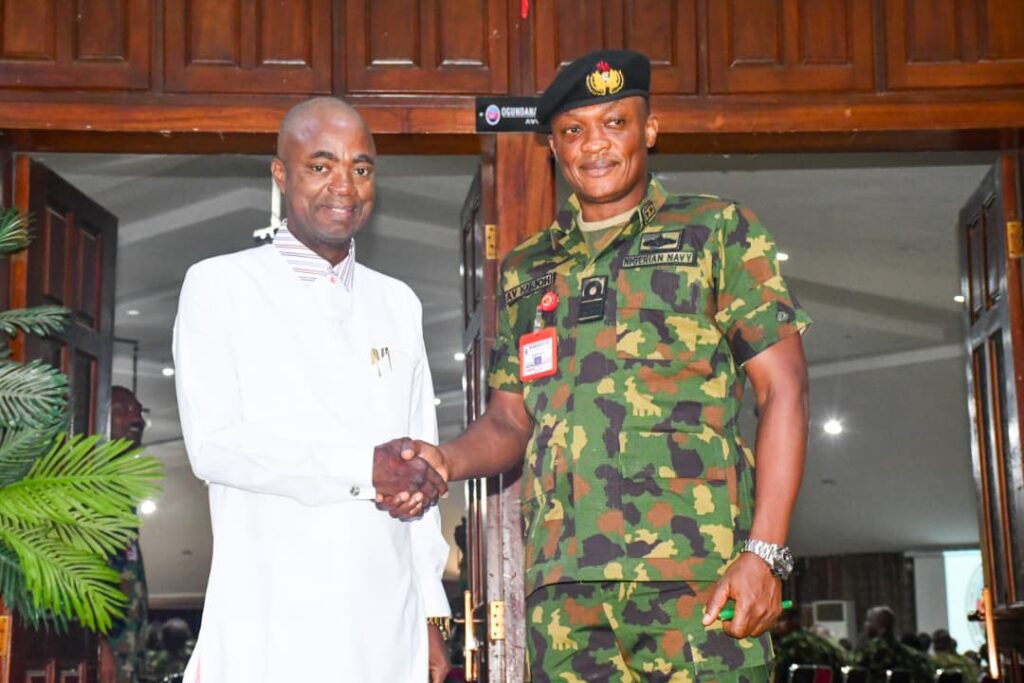

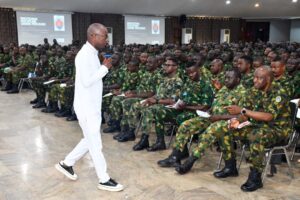

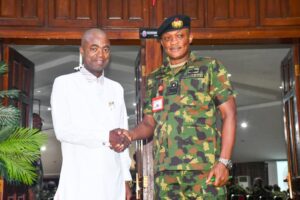
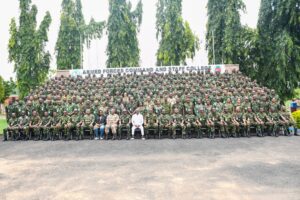
The President of Security Resources & Risk Management Academy, Lagos, Matthew Ibadin, who is also a doctoral researcher at the Nigerian Defence Academy (NDA) and University of Abuja has advised officers and men of the Nigerian Armed Forces and officers of other agencies to always be conscious of the consequences of unmanaged anger both in their places of work and at home with family members.
Delivering a lecture to 436 Army, Navy, Airforce personnel and other officers from eight friendly nations “On Emotional Discipline Under Pressure and Anger Management for Staff Officers,” in the Senior Course 48 at the Armed Forces Command and Staff College, Jaji Kaduna on Monday; Ibadin defined Anger as a temporary madness that leaves a permanent record with a warning that nobody should think it cannot be him, emphasizing that the “line is thinner than one can imagine.” He emphasized that undisciplined anger can become a greater threat than the enemy.
He told the officers that one of the practical tools one can use immediately at home, in the office or in command position while under pressure, during conflict or in difficult decision-making situation, is to hold fast “as anger may enter the room, but must never take command.” Illustrating this point with the parable of the lions, he cautioned that even though both male and female lions roar at every sound, the female lion roars only when necessary, explaining that “she lives longer not because she is weaker but because she is more disciplined.
Ironically, “Many of us have become ‘male lions’: fighting juniors, spouses, traffic,
phone calls, minor disagreements — even when no real threat exists,” Ibadin noted. He added that, “that constant agitation slowly destroys what you have built.” He has therefore charged every officer to “be a female lion in strategy — and a male lion only when tactically necessary” even as he posited that “this is not weakness.”
He advised them to always discern and “Know which battles deserve your energy,” as “authority does not require constant aggression” while “the strongest person in the room is often the calmest.” Illustrating his position further, Ibadin adopted the Aristotelian five tests that explain anger as human with its discipline residing on how it is expressed namely the right person? Right reason? Right time? Right degree? And Right manner? According to him, the mature officer does not eliminate anger but disciplines anger.
While explaining anger in a military context, Ibadin said anger is not indiscipline but information that may signal standards violated, mission threatened, injustice felt, expectations unmet, disrespect perceived or operational setback. He advised that while feeling angry, an officer should pause to assess, verify facts, asks questions, and make sound decisions rather than react in a manner that immediately assumes facts, shouts accusations and makes impulsive decisions.
He however, pointed out that one can be deeply angry without shouting, insulting, threatening, humiliating, striking, taking impulsive decisions or abuse authority as officer should always bear in mind that he is leading people who carry arms, take decisions that affect lives, represents an institution and his actions can shape missions and careers. He should be mindful of the fact that his action can make national headline that could likely cause institutional embarrassment, damage his home and his years of diligence may be undermined in a single second.
Speaking on the battlefields where anger destroys, Ibadin noted that health is a victim as anger is a silent killer as it can trigger off high blood pressure. Chronic anger in his words can resort to hypertension, stroke, diabetes cardiovascular disease, chronic ulcers, accelerated physical decline. The home front is another battlefield of anger and for every officer, his rank expires there, he cautioned them. How many officers survived the war front but did not survive peacetime? he asked.
“At Jaji your rank commands respect but at home, your rank is irrelevant. Bringing command style home destroys sanctuary. An officer whose home is under emotional fire cannot think clearly in the command post. If you win at the office and lose at home – you have lost” he cautioned.
He also reminded officers that in decision making, the signature one regrets most is the one signed while angry, pointing out that impulsive decisions affect operational orders, procurement, personnel assessment, promotions and critical reports. The consequences of these, he noted; include boards of inquiry, career ruin and mission impact. Ibadin has therefore advised that officers should never allow emotional urgency to replace professional analysis since the higher the rank, the heavier the cost.
About Author